And no sooner had I posted the previous entry, packed up the electronics, and started readying myself for sleep rest closing my eyes than there came a knock at the door, telling me it was time to move to my new room NOW!
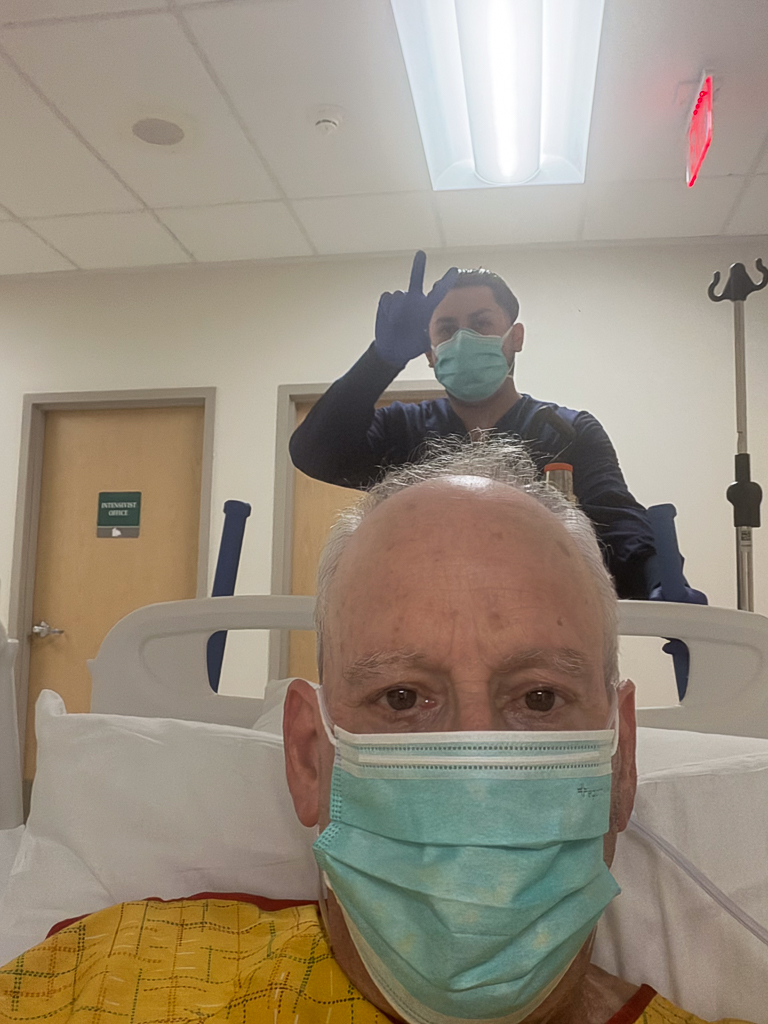
The journey was uneventful (and short), but I had to do a little unpacking when I got there, so it was well after 11pm before I made another attempt to fall asleep.
It was not very successful. When I awoke Tuesday morning, Apple told me that I’d slept 3 hours and 41 minutes; I think Apple was generous. Of course there were the usual hospital interruptions during the night; there was also a fire drill, which I completely ignored (I was awake, but nobody came to check on me – eventually, I called the nursing station who told me that all was well).
I was not energetic during the day and fell asleep about 7:15pm.
Wednesday morning was better. I’d slept almost 7 hours and felt nearly human! My nurse told me my vitals were moving in the right direction and there was a chance I might get to go home if all went well.
I was completely off the oxygen, and they took out the nasal canula. They took me out for a test walk with an oximeter monitoring my oxygen saturation – I logged it as a “indoor walk”: 0.06 miles in 4:17, burning 6 active kilocalories. I was movin’!
And the hospitalist agreed to let me go home (reluctantly – I’m sure he’d have preferred me to spend one more night in the interest of safety; I wanted to go home in the interest of sanity).
Diane came to get me, and the nurse took me through the discharge paperwork and made sure I understood my instructions and medication dosage schedule. I was thrilled to discover that there was no need to visit the Business Office – instead, a volunteer put me into a wheelchair, Diane brought the car over, and we went home!
It was great to be home; Diane had made salmon and salad, and there was some left over, so she warmed it up. It was delicious.
We went to bed about 9:45; I slept until 7, giving me nearly 8 hours of sleep. No one prodded, poked, or medicated me during the night. Lovely!
Today has been busy – I unpacked and put away the electronics and other things I hadn’t had the chance to deal with before going to the hospital.
I’m working on getting appointments with my PCP and with my cardiologist, and the Good Samaritan “Nurse Navigator” called me to ask how I was doing, whether I needed any help, and whether I had any questions…which she answered.
Rabbi Rafi at Shir Hadash called me to see how I was, but we had a hard time connecting – his calls went directly to voicemail on my phone without the phone ringing! I saw the voicemail of one of those calls just a few seconds after he left the message and was able to call him back, but I have no idea where to start figuring out what’s going on…so I just asked Siri AI for help, and it came through – T-Mobile’s “Scam Shield” categorizes Shir Hadash as a “Charity Call” and sends it to voicemail. I put the number on the “Allowed” list – I’ll see if that helps.
We made lunch and dinner, which was a pleasure.
It’s still going to be an early night tonight; I have almost 4,000 steps, which usually would mean I was stuck on an airplane or quite ill, but under the circumstances, I’m thrilled to see such a high number!
Tomorrow, I hope to have something more interesting to write about…like getting Home Assistant (home automation) updated to the current version.